
Oct 9, 2026Journal
IP65, IP66, IP67: Which Rating Does Your Garden Line Need?
IP65, IP66 or IP67? A plain-language guide to choosing the right ingress protection for every position in a garden lighting range.
An IP rating looks like a technical formality. In a garden lighting range it is a placement decision wearing a technical costume: it decides where a fixture can live, how long it will last there, and what your after-sales looks like three winters from now.
Here is how to read the two digits, where each rating belongs in a garden range, and the questions that separate a real rating from a sticker.
Reading the Two Digits
The IP code (as defined by IEC 60529) has two numbers. The first describes protection against solids — dust, grit, fingers — and the second describes protection against water:
- IP65 — dust-tight; protected against water jets from any direction.
- IP66 — dust-tight; protected against powerful water jets.
- IP67 — dust-tight; protected against temporary immersion in water.
Notice that the numbers do not measure "quality". A beautifully engineered IP65 fixture outlives a badly sealed IP67 one. The rating is a promise about environment, not a score.
Where Each Rating Belongs
Position in the garden | What it faces | Sensible rating |
|---|---|---|
Wall light under an eave or on a facade | Rain, wind-driven spray, hosing of the facade | IP65 |
Bollard and path lights in lawn or driveway | Sprinklers, hose-down, soil splash | IP65 |
Spike and spot lights in beds and borders | Irrigation zones, direct hose spray at close range | IP66 |
Inground uplights in paths, decks and lawns | Soil contact, standing water, frost, drainage reality | IP67 |
A professional range does not carry one rating for everything — it carries the rating each position actually needs, and the documentation to prove it.
What Makes a Rating Real
Two fixtures can share the letters IP67 and behave completely differently in year five. The difference is in the sealing architecture:
- Gaskets — silicone, properly compressed, with a design that keeps compression over temperature cycling; not foam strips that take a set.
- Glands and entry points — a cable entry that lets water in is a failed seal no matter what the housing does.
- Optics protection — tempered glass where impact and thermal shock matter; PC or PMMA diffusers where flexibility and cost matter more.
- Driver compartment — potted or separated, because electronics tolerate moisture far less than aluminium and glass do.
- Testing — the reports behind the declared rating, from a recognised laboratory, on the actual production configuration.
A certification claim is the beginning of the evidence, not the whole of it. Ask which test reports back the IP number, and whether they were run on the same construction you are ordering.
In the Ranges We Supply
The placement logic above is how our 2026 ranges are actually organised, model by model:
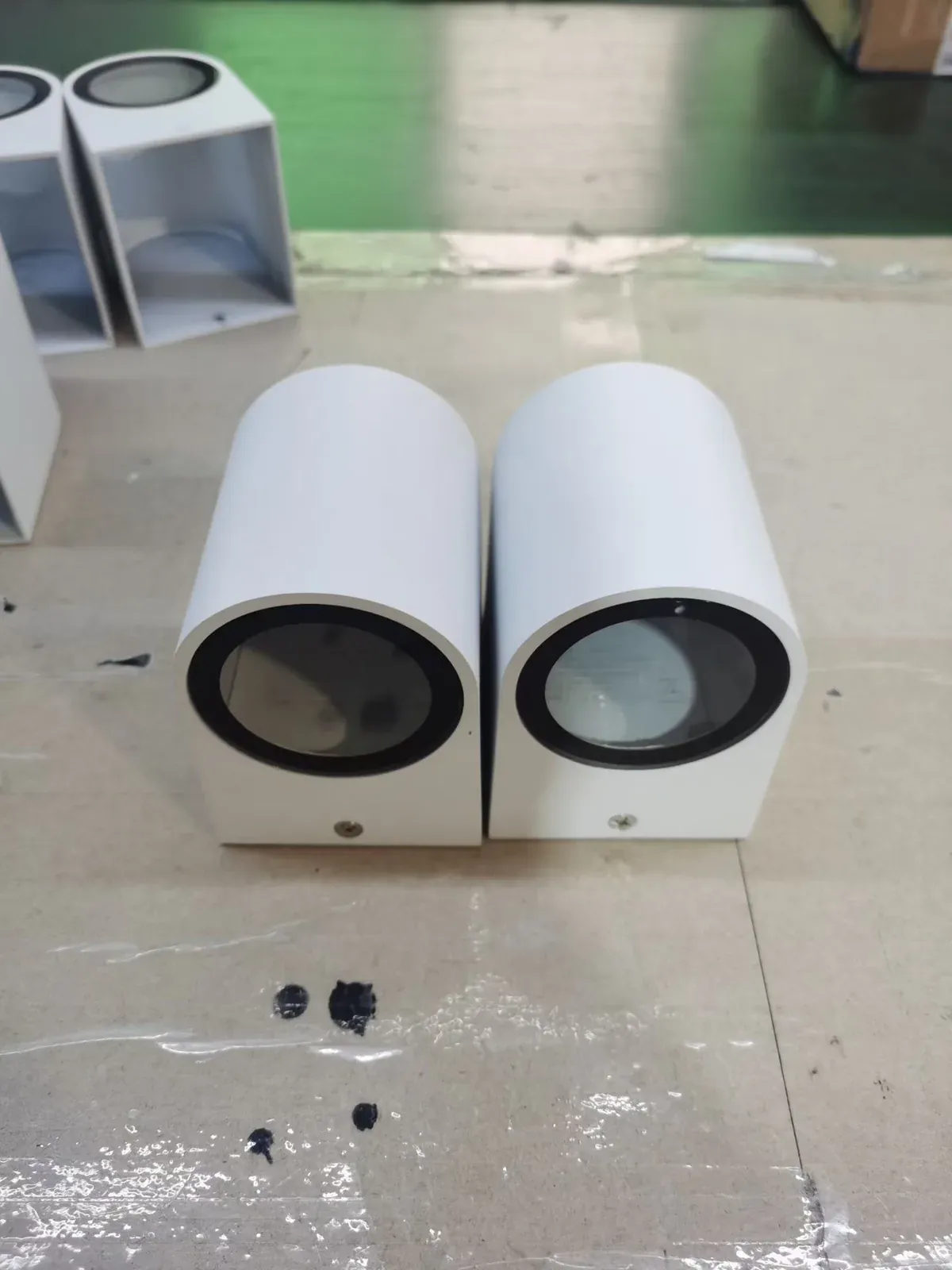
- Wall and bollard families — IP65. For example the NA-3047/3048 wall lights (LED 12W or E27, 220–240 V, 145×110×210 mm and 145×110×320 mm) and the NA-3105 wall light / NA-9008 bollard pair (5W, 90×90×150 mm and 90×90×650 mm).
- Inground uplights — IP67. For example the NA-8308 family (GU10, Ø100–120 mm, 125–140 mm deep) and the NA-8216/8217 side-emitting uplights (3W/6W, 120×80 mm).
Every model page carries its IP rating, colour-temperature range (2700–6000 K) and warranty term next to the light source and dimensions — and the ratings rest on institutional test equipment: an integrating sphere for photometrics, environmental chambers for ageing, and impact testers for IK.
Impact Ratings — the Forgotten Partner
Water is only half the story. Driveways, plazas and public spaces also deliver impact: delivery vans, lawn equipment, playing children. IK impact ratings (IK08, IK10) describe how a fixture survives mechanical shock, and professional specifiers increasingly ask for both numbers together — IP for water and dust, IK for the boot that hits it.
Three Mistakes Buyers Catch Too Late
- An IP65 fixture installed below grade. Standing water is not a water jet; a path uplight needs an immersion-rated construction and a drainage plan.
- A higher IP number with no drainage design. The best seal in the world does not help if the housing sits in a bowl of water. Inground fixtures need the installation detail, not just the product.
- IP claims without reports. A number in a catalogue is a marketing claim until a test report on the production configuration backs it.
FAQ
Do garden lights need IP68? For ordinary garden positions, no. IP68 is defined by the manufacturer for a specified depth and duration — relevant for fountains and submerged applications. IP67 covers garden positions exposed to standing water; wall, bollard, spike and spot positions are fully served by IP65 and IP66.
Can I use IP65 fixtures for spike lights in irrigation zones? IP65 protects against jets, but a spike light sits directly in spray reach, often low where water pools. IP66 is the honest specification for that position — and it is what we ship in our spike and spot range.
Will a higher IP rating make a fixture more expensive? Usually, yes — better seals, potted drivers and tempered optics carry real cost. That is exactly why a range organises ratings by position rather than across the board: spend the sealing budget where the environment demands it, and keep the garden line sellable.
Planning a garden lighting range and unsure how to structure the ratings? Send us the four inputs — design reference, technical parameters, target budget and estimated volume — and we will reply with a feasibility view. [Start a project](https://www.noorarchlighting.com/contact)
New here? [Browse the collection](https://www.noorarchlighting.com/products?category=inground): wall lights at IP65, spike and spot at IP66, inground uplights at IP67 — the placement logic of a full garden range.